
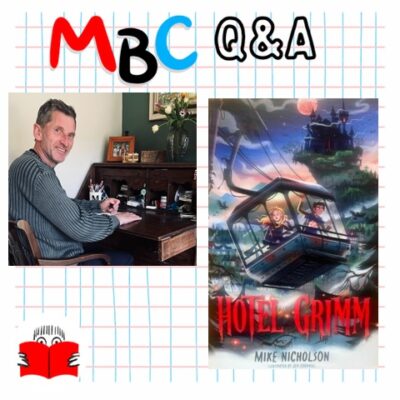
1. Hotel Grimm has a fantastic origin story, can you please share with us the history behind it from when it was originally created to where it is now?
It all started in the early 2000s when I read about big companies spending loads of money on rebranding – sometimes a tweak to a famous logo cost millions of pounds to design and implement. My curious mind wondered what would be what the hardest thing to rebrand. I reckoned it would be a hotel where the last few guests had died in slightly ridiculous accidents (I know, I worry about the way my mind works too!).
I thought this was an interesting idea to play around with and began writing what I called ‘Rebranding Hotel Grimm’. Somehow I need a main character who was a child but was regarded as a world expert in marketing. So I came up with Rory McKenna who had created a successful slogan for a fizzy drink company. However, only he knows that he heard someone else saying the slogan – he’s no expert at all and has been living a lie. As the story starts he’s in an impossible situation – a deadly client he can’t refuse, yet with no skills to do the job they need – Hotel Grimm.
It wasn’t really landing until I realise that the heart of the story was about the truth – what is really happening at the hotel? Is it as bad as people think? Are the local newspaper’s constant negative stories accurate and if not, why not? That realisation came out of stories in the aftermath of the London terrorist attacks as people’s fear turned into discrimination against innocent people. That was a massive turning point. The idea of truth, fear, discrimination and fake news guided the story from there and those became themes that some schools subsequently used the book to explore. However, Hotel Grimm can equally just be read as an intriguing and darkly comic mystery.
Originally the story was published by Floris Books in 2008 as Grimm, but went out of print 10 years or so later. I’m bringing it back in 2026 – redesigned, revised (10,000 words shorter!) and soon to have a school resource to go with it, partly because I feel the themes it covers are more relevant now than ever before.
2. The difference between the truth and lies is a huge theme running through Hotel Grimm, was Rory’s story how you imagined it when writing the first draft? It must have taken a lot of planning to get the storyline to work with all the incredible characters back stories and relevance to the plot?
The theme came as I was playing around with the story rather than setting that theme out and working with it. I find I write by creating characters and writing them into scenes that just seem to work. It’s a bit disjointed but I get very visual film-like ideas for scenes and write them quickly, getting quite caught up in the action. I therefore end up with a jigsaw of pieces and have to then work out a timeline they fit into and a plausible plot which enables these things to hang together. It’s odd – I don’t end up with written-up scenes that I discard; the ones I write all seem to find a home eventually. So planning is not a strong point (!), and certainly not a way I start to write a story.
3. With a fantastic supporting cast to help Rory along the way, which is your favourite character? Are any based on you or people you know?
Yes there is a hefty list of names! I like Rory’s Grandad Hugh, who is housebound but slowly reveals a very active and interesting past including a connection to the infamous hotel. Ramsay Sandilands the rat-owning hotel chef is fun to write as he’s quite full of himself so I like his scruffily ridiculous pomposity. No-one is really based on anyone I know, but some of the character names have been pinched from people I know like the librarian, Rory’s Mum and the list of dead guests includes corruptions of my former flatmates’ names for a laugh. I thought it would be fun to kill them off and to see if they actually read my book and spotted what I’d done. They did eventually but it was some months after the launch which was quite funny!
4. Set in the fictitious town of Aberfintry, is Hotel Grimm based on a place you’ve been before? Have you ever stayed at a hotel like Hotel Grimm?
Being up on the hill and near to Hotel Grimm, and looking back down into the town is an important perspective in the story. This idea and image was helped along when we were staying with friends in Aberfeldy and looking down to the town from the hill where they lived. So as a result I called the town in the book Aberfintry – as a made-up Scottish sounding equivalent.
I’ve not really stayed anywhere like Hotel Grimm although my wife and I sometimes describe places like ‘being a bit Scooby Doo’ if they feel a bit abandoned with potential for a dodgy caretaking character popping out from some corner or other! We’ve been at a couple of places like that!
5. Jen Chennell’s illustrations and cover are fantastic! What’s the creative input from you as the writer, do you provide the illustrator with a brief description of what you’re looking for or do they have artistic freedom to create their vision from your words?
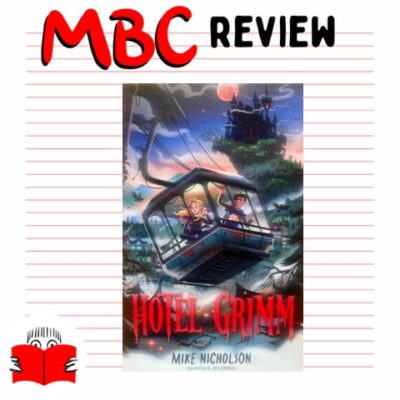
Jen has done a brilliant job. I absolutely love the cover. When I was in my early teens, I loved Alistair MacLean books and Where Eagles Dare was a favourite. In it there is a rocky hilltop fortress called Schloss Adler which connects with ground level by a cable car. This image was firmly in my mind as I wrote Hotel Grimm.
I sent a couple of Where Eagles Dare images to Jen when she still had a blank page. What was brilliant was she took the time to read the book and then came up with the image which felt very ‘right’. There are lots of wee details in the cover illustration which link to elements of the story; a graveyard, crows, telescopes in the cable car, Rory with a Zizz Cola t-shirt etc. She put all of these little references in which I massively appreciated. We also decided to have an illustration where each of the chapters begins with a rhyme or extra info linked to the hotel. I gave Jen a list of things which happened in those chapters, like a candelabra, wolf statue or gasmask so there was a teaser to what was coming up next.
6. What are you working on next?
I’ve got a half-written children’s novel with a bit of a dystopian feel to it – inspired by the Bass Rock in East Lothian and the fact that there used to be a prison located on it. What is it with me and these difficult-to-get-to places with buildings you might want to avoid?! It’s been half-written for a while so this needs to be the make-or-break year.
There’s also a real-life World War I Edinburgh-based story I’m researching which would be for an adult audience and might need a factual retelling of the story. I’ll see what emerges!
Read our My Book Corner review of Hotel Grimm here!
About Mike Nicholson
Mike Nicholson’s love of stories began early, through comics and cartoon books and with regular trips to Dalkeith Library, near to his childhood home. Here he discovered a love for mystery, adventure and science fiction.
Many years later, working with primary schools to create wildlife areas, he began writing for children. Spurred on by writing competitions, which offered prompts, deadlines and prizes, he was longlisted in a BBC ‘first chapter’ competition.
Encouraged by positive feedback, he turned that first chapter into the book Catscape – a story inspired by numerous lost cat posters near his home. This Edinburgh-based mystery won the 2005 Kelpies Prize.
Other books followed, including rhyming picture books and the six-book Museum Mystery Squad series, inspired by visiting the National Museum of Scotland.
Read more about Mike and his writing life here.

Leave a Reply